Laminex®
“The Sky’s The Limit”

Recent discussions with George the Joiner have highlighted just how much Laminex® is going into my new house. I love the stuff. It’s durable, versatile, familiar. But what exactly is it made of? Plastic? Not exactly. It’s mostly made of … paper. Though it is bonded together with “thermosetting resins”, typically synthetic polymers derived from petrochemicals.
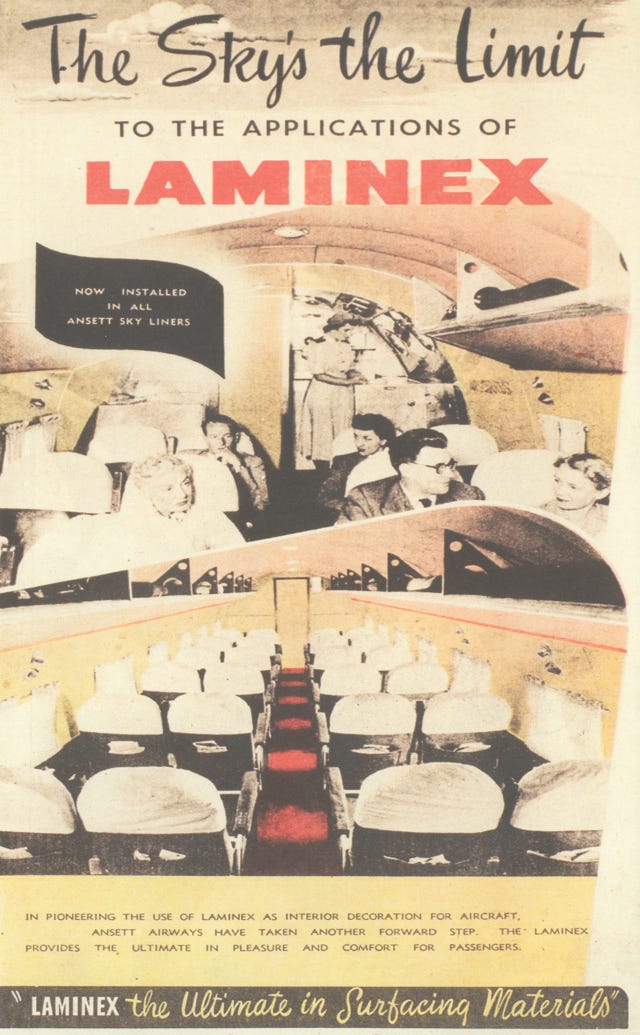
“The Ultimate in Surfacing Materials” — “Now installed in all Ansett Sky Liners”
Been around for years
Laminex®, that material familiar from childhood kitchen table tops, has been made in Australia for 90 years, originally in a tin shed in Brighton. A bloke named Bob Sykes started the business in 1934. Bob started out making insulation sheets. After WWII, an American trend for using decorative laminates in homes began, and by the 1950s every on-trend Australian house seemed to have a Laminex® benchtop.
Given how long the stuff lasts, some of these may still be going today.
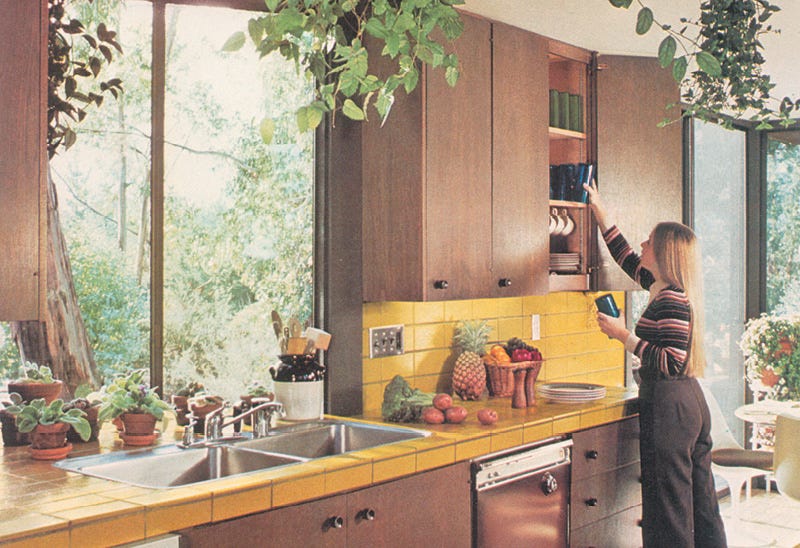
Was this your Mum’s kitchen?
Laminex® continues to manufacture in Australia—including sites in Cheltenham and Ballarat in Victoria; Bathurst in NSW; Gympie in QLD; and Dardanup in WA, serving both residential and commercial sectors
A Mid-Century Modern Trend
I’ve always been aware that mid-century architects embraced new materials as part of a broader commitment to modernity, efficiency, and industrial production. Advances in reinforced concrete, steel, glass, and laminates allowed them to build lighter structures, larger spans, open plans, and make a closer visual connection between indoors and outdoors. These materials also carried a symbolic break from historical styles, aligning architecture with postwar optimism and technological progress.
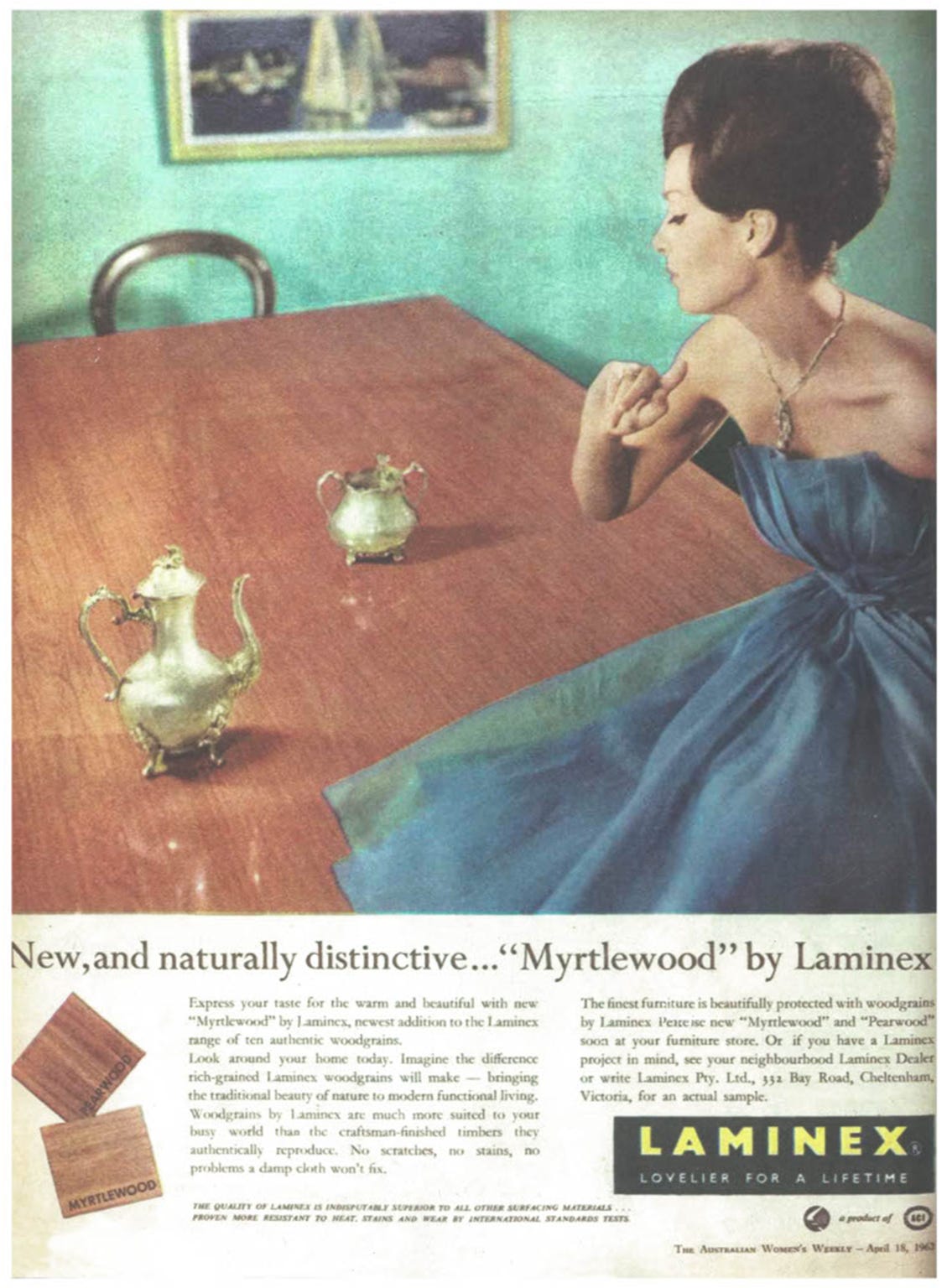
“Myrtlewood” in the 1950s: “Lovelier For A Lifetime”
In Australia, Harry Seidler exemplified this approach. Influenced by Bauhaus-trained figures such as Walter Gropius and Marcel Breuer, he used industrial materials with precision and restraint. Early works like the Rose Seidler House feature steel framing, large glass panels, modular planning, and factory-made components (though that bitumen-based tile he tried on the floors wasn’t so successful.) For Seidler, new materials were not just decorative novelties but integral to a rational, forward-looking architecture which prioritised function, clarity, and spatial openness.
So plenty of Laminex® is well within the ideas and aesthetic of mid-century modern design.
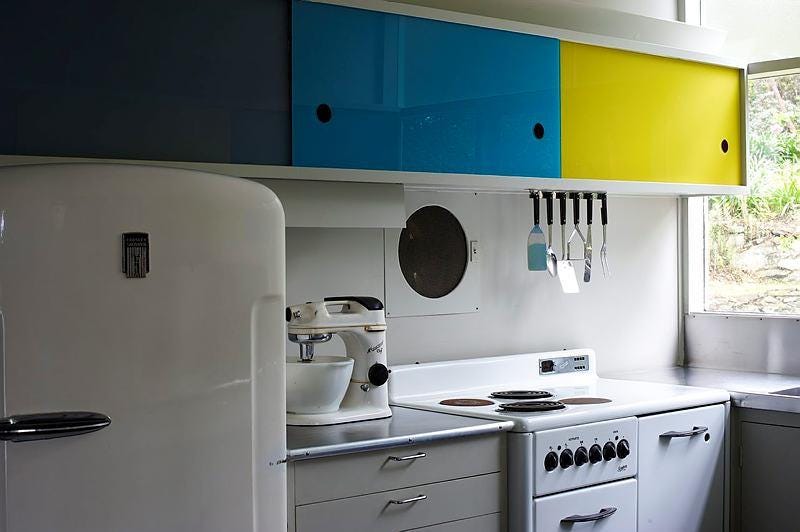
Laminates (though not necessarily Laminex® brand) in the Rose Seidler House, 1950.
What exactly is it?
But what exactly is it? Laminex® (and other “laminates”) are ubiquitous interior surface materials in our homes, but who knows what it’s actually made of, and how?
Here’s the dictionary definition of the verb “to laminate”:
laminated; laminating
transitive verb 1 : to roll or compress into a thin plate 2 : to separate into laminae 3a: to make (something, such as a windshield) by uniting superposed layers of one or more materials 3b: to unite (layers of material) by an adhesive or other means
intransitive verb : to divide into laminae
The noun is lamina (plural: laminae or laminas), meaning a thin plate or scale; a layer.
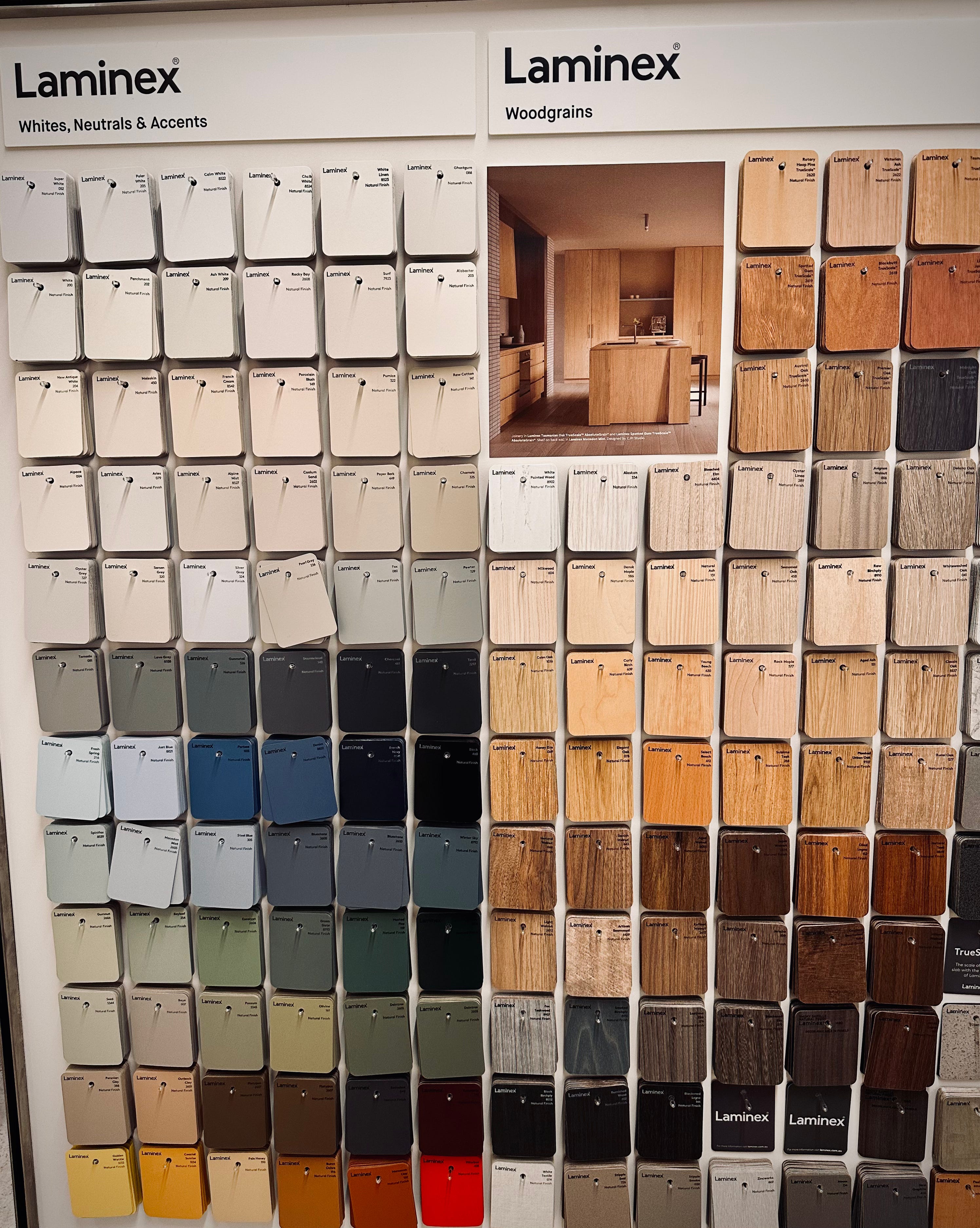
Choices: at the Showroom
Manufacturing Laminex®
Apparently you start with “Kraft Paper”, lots of it. “Kraft paper” is a strong, durable, and eco-friendly paper produced from wood pulp using a chemical pulping process, known as the “kraft process”. It’s known for its high tear resistance and, while usually brown, can be bleached white. Kraft paper is widely used for heavy-duty packaging, such as shipping bags, grocery bags, wrapping paper, and carton liners.
And for making Laminex®
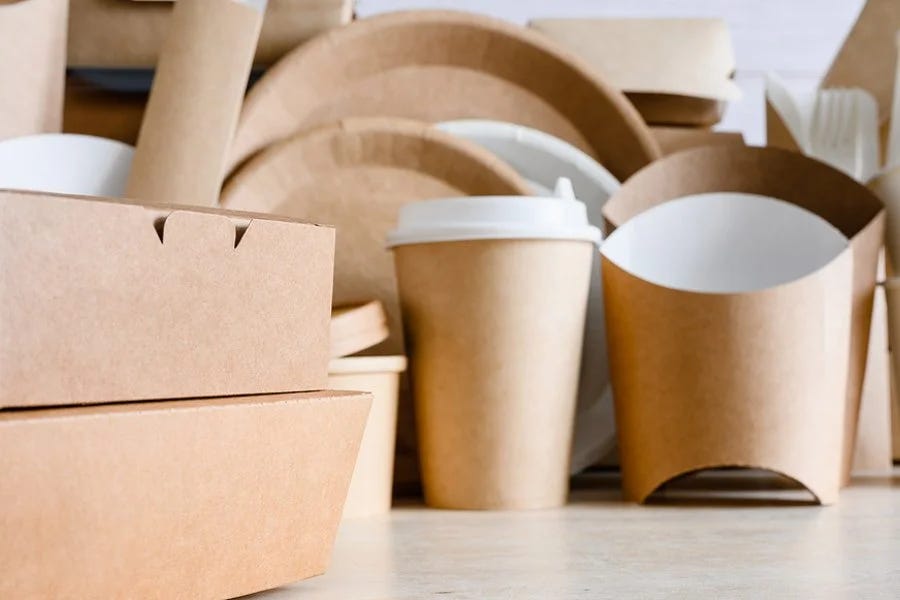
This is Kraft paper used for packaging (source)
Laminex® is made by stacking layers of kraft paper impregnated with phenolic resin to form a dense core, then adding a top layer of printed decorative paper soaked in melamine resin.
This layered sheet is subjected to high pressure and heat in a press, curing the resins so the layers fuse into a rigid, durable panel. The surface becomes hard, smooth, and resistant to wear, moisture, and stains.
After pressing, sheets are cooled, trimmed, and finished, then bonded onto substrates such as particleboard or MDF for use in benchtops, cabinetry, and wall panels.
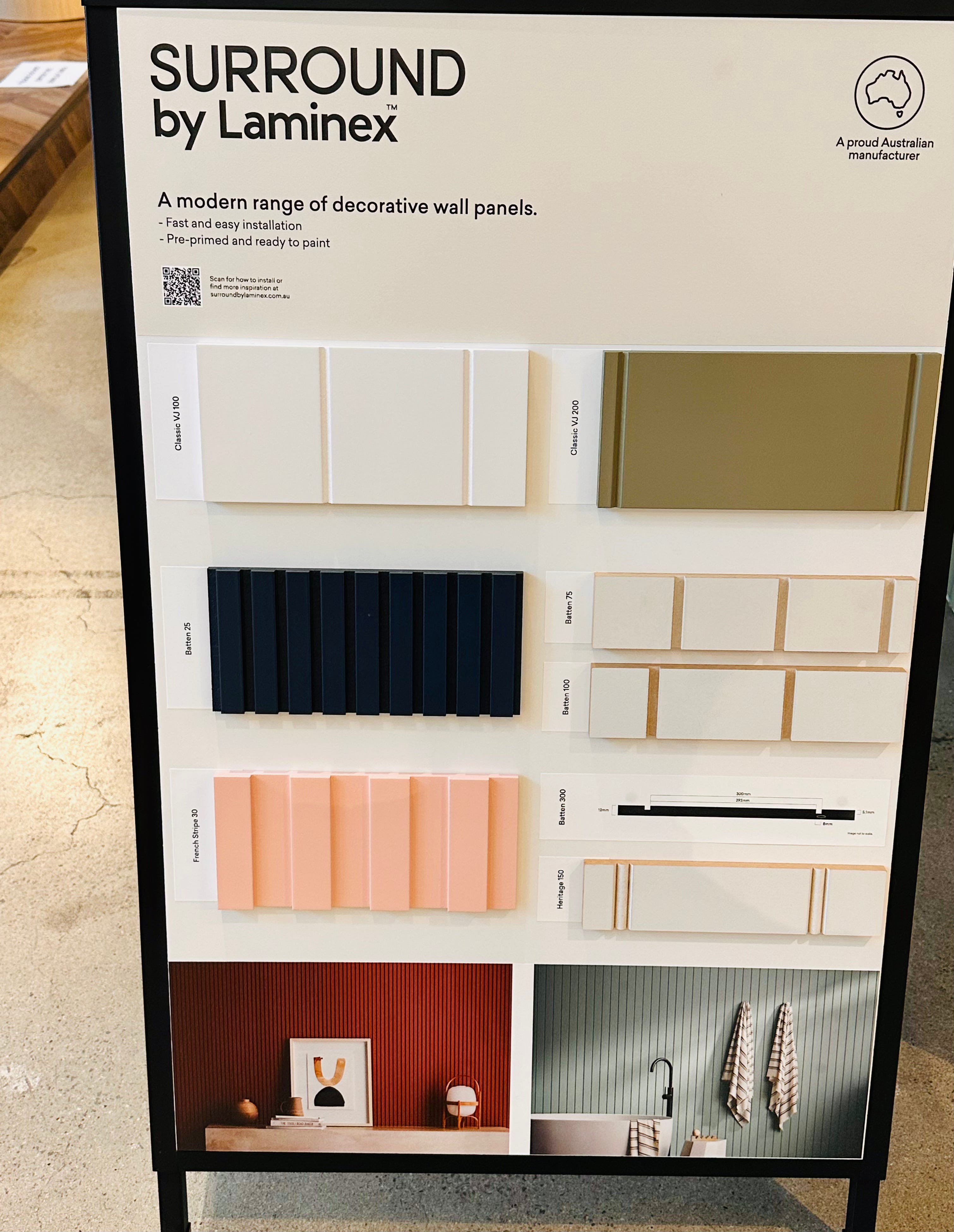
Decorative wall panels: mimics (nearly) anything
Is it eco-friendly?
Partially. Laminex® has some environmentally positive aspects. It is largely made from paper (wood pulp), which can come from renewable or certified forests, and some products include recycled content. It’s star advantage is its durability. Because it lasts many years, it reduces the need for replacement and therefore waste.
However, it also uses synthetic resins (phenolic and melamine), which are petrochemical-based and energy-intensive to produce, and the finished material is difficult to recycle.
On the Laminex® website, the company says it’s about:
“incorporating ethically-sourced materials into our ranges. We are proud of the positive progress we have made on our sustainability journey.
The transition to the circular economy and the journey to net zero is far from over. We maintain a conscious commitment to environmental and social sustainability and achieving our sustainability goals across all of our operations.”
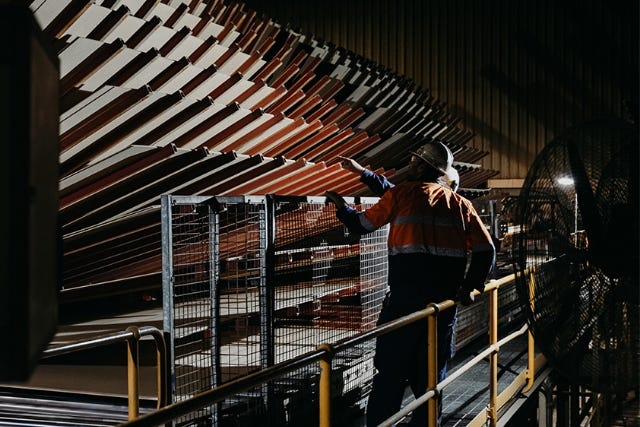
Manufacturing Laminex® locally (source)
For the history of the brand, check out this excellent blog by The Interiors Addict.
For the past 90 years, Laminex have consistently set the benchmark for material innovation, leading to an extensive product range that has expanded to include modern laminates, acrylic surfaces, wall panelling products and more. For many Australians, Laminex products have been a fundamental part of their households – bringing durability, functionality, and personality to the heart of the home.
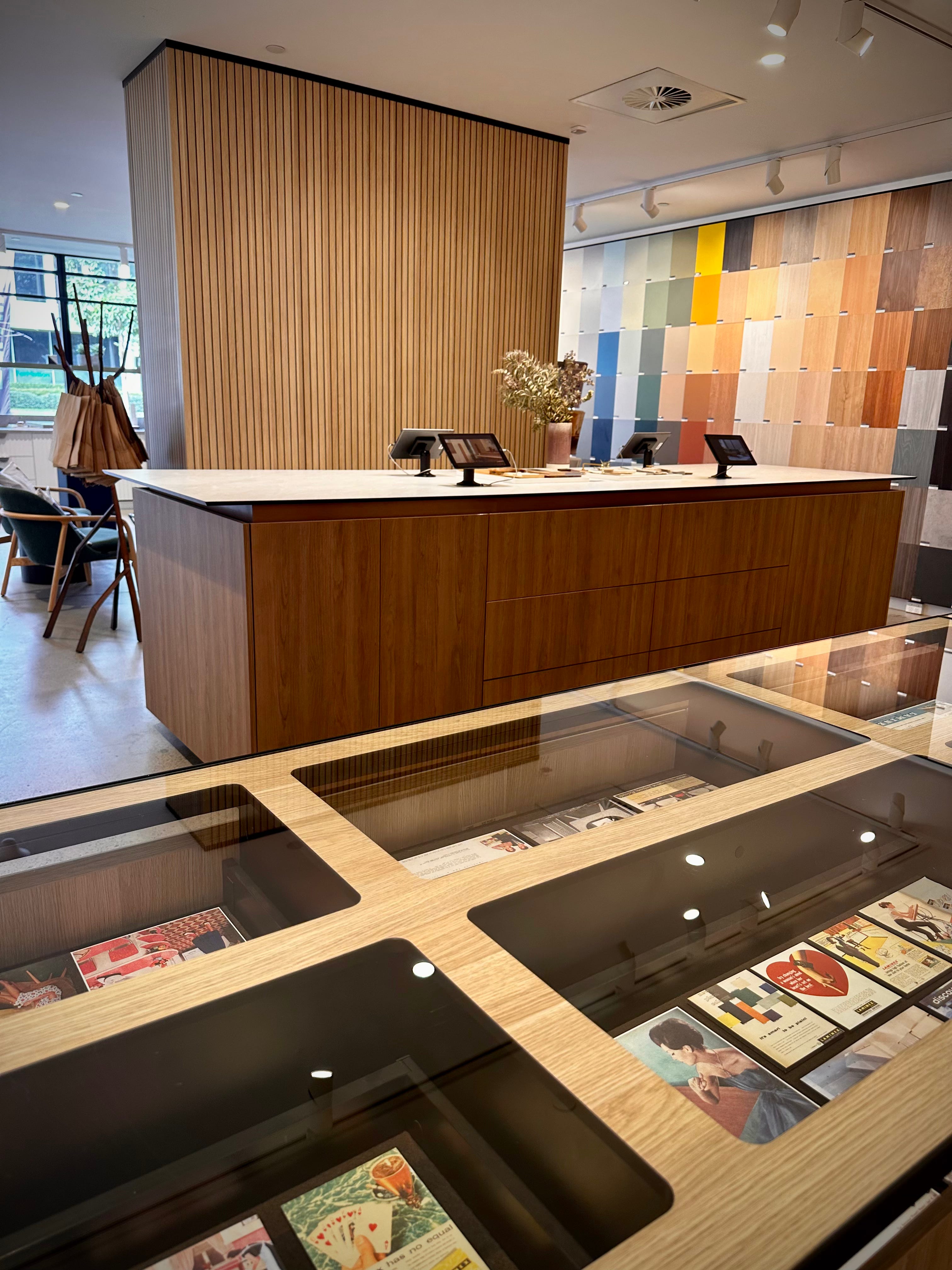
At the showroom
A visit to the motherlode
Conscious of how vital the Laminex® choices would be for my house, I made a trip to Alexandria to the big showroom there. In particular, I wanted to see their “Architectural Panels” in large format, since that’s how they will look on the walls of my house.
Yes, Laminex® make more than coloured benchtops. In fact, the product can imitate many natural materials, notably woods. It’s also made in a variety of different panels mimicking other materials, such as V-joint boards, metallics, and ceramic tiles. They can even make up custom art into Laminex® panels. In the face of this myriad of choices, I tried to stay focussed in the amazing showroom. For my house, I was after a product which mimics wooden battens.
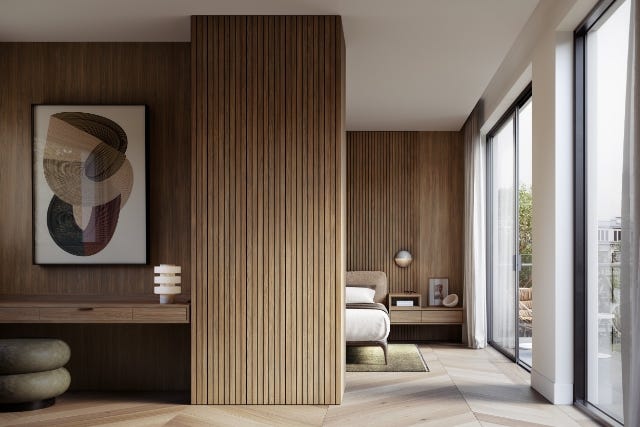
Wooden battens? No, Laminex®
All the options
Don’t be fooled into thinking that choosing the colour is the only decision. There are also options such as the “Absolute Grain” surface finish which mimics woodgrain, vs. “Natural” (smoother); and a variety of different edges. Here’s something you may not need to know, but I never let a good acronym go by unchallenged:
“ABS edging” is the standard modern, durable plastic edge finish used to protect and complete Laminex® panels. And what does “ABS” stand for? Acrylonitrile-Butadiene-Styrene. It’s basically plastic which is applied to the exposed edges of laminated boards (e.g. the MDF or particleboard).
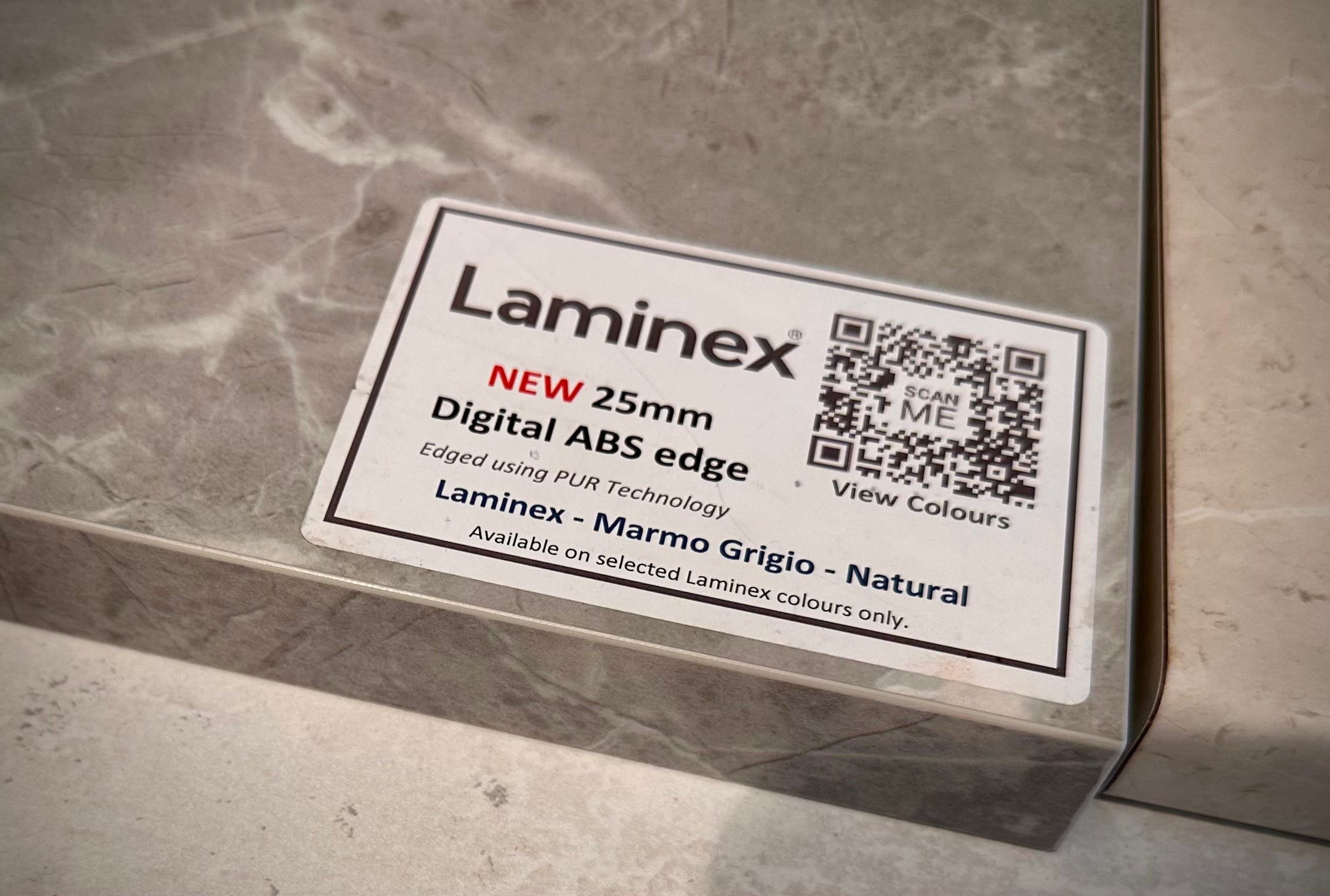
But wait, there’s more: how about digitally printed ABS edge tape with polyurethane (PUR) adhesive? * choice overload *
The Colours
But moving on from the technical to the fun part, what colours to choose?
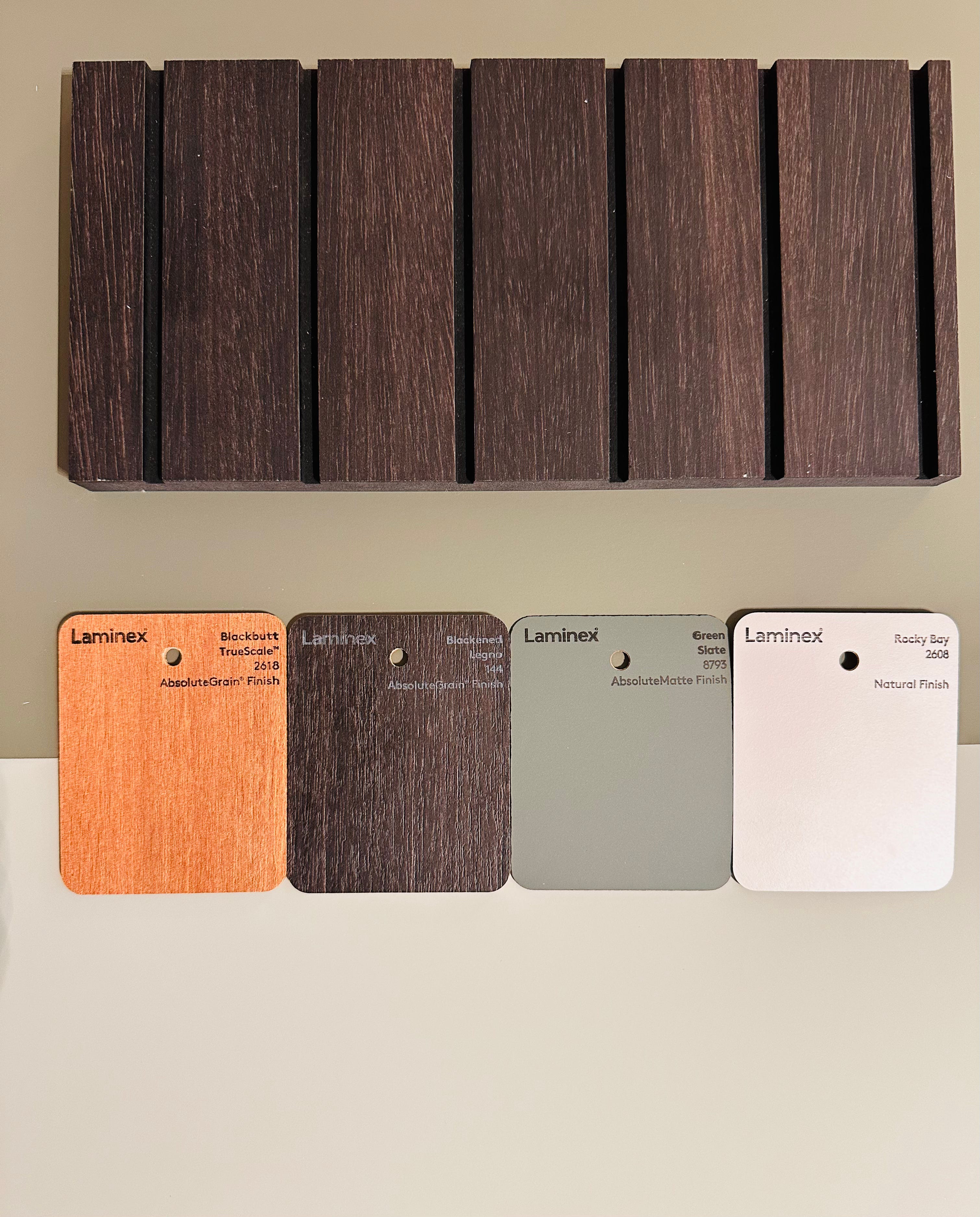
I went into the showroom knowing that I want heaps of the Australian timber colour Blackbutt “Absolute Grain” in my house, and I needed to see it in a large sheet as opposed to a tiny little sample. I wasn’t disappointed – it’s going to look great.
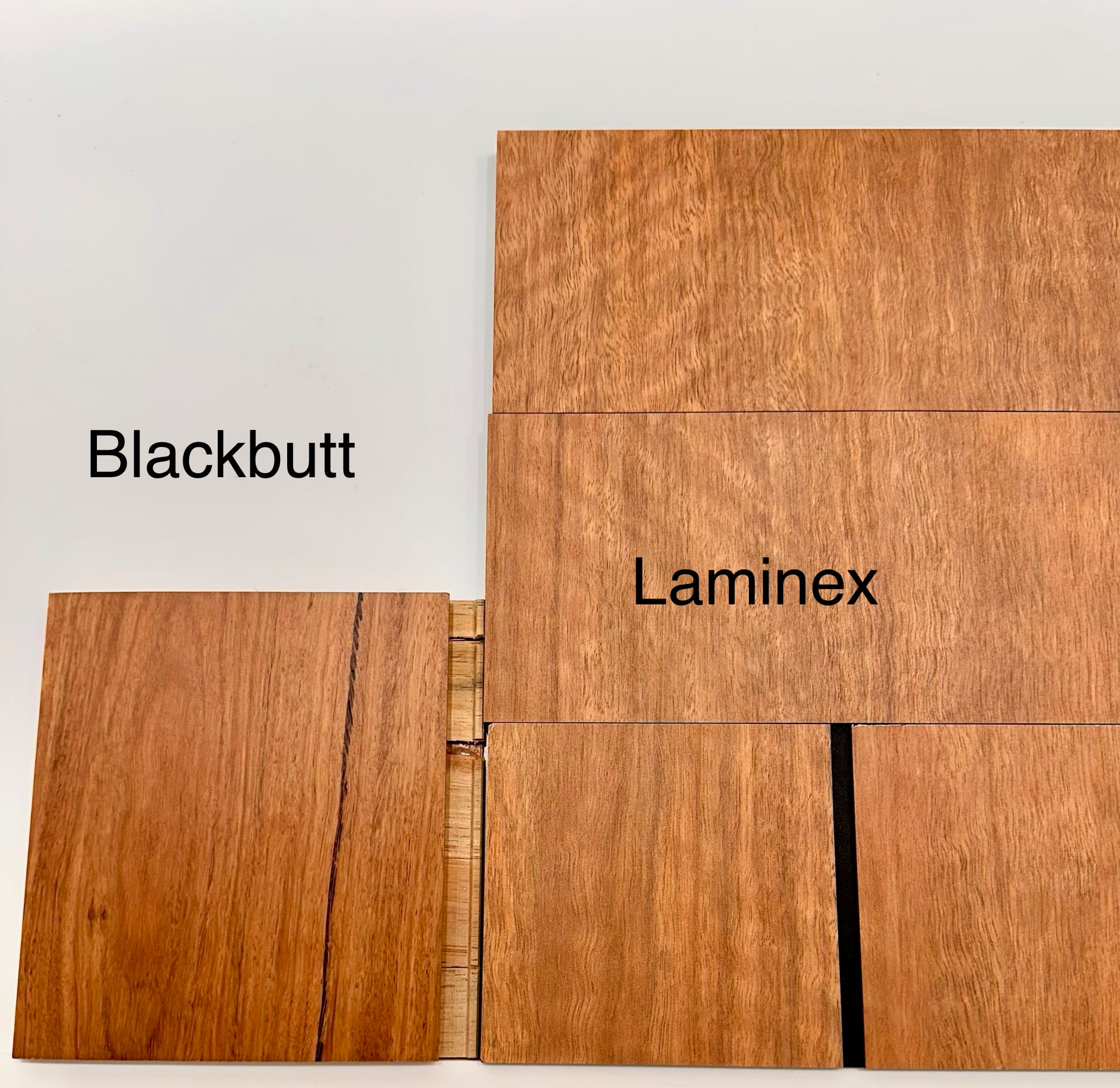
I checked out the colours of the Architectural Panel ‘shadowline’ battens (which come in different widths) and tried it against the woodgrain of my flooring choice, and opted in the end for a dark colour: “Blackened Legno” (legno (it.) = wood)
To break up the Blackbutt theme throughout the house, I’ve also specified some cabinetry in the same Blackened Legno colour.
I wanted a green, something in the tones of the Australian bush. As mentioned in my last post, the Green Choice Discussion went on for some time with the interior designers, but eventually we landed on a colour called “Green Slate”.
Then, just this week, a crisis of confidence had me changing the specs for the Laundry. A small room full of Blackbutt? Maybe not, I thought. So we’re now going with a pale, almost white colour called ‘Rocky Bay’. It has a faint tinge of pink in it, unnoticeable unless you put it against pure white, but I like the idea of a faint echo of pink rosellas in a house of bush colours.
Here are the final Laminex® colour selections. The background colours in this photo are Dulux paint samples in ‘Currency Creek’ (the darker green) and ‘Waltzing’.
The photo doesn’t really do justice to the colour samples, but you get the idea I hope.
A house full of Laminex®. Just like Mum.