
Building Quotes
How much will it cost?

Now that we have a DA approved, we need a builder to turn the dream into reality. Behind the scenes, lots of discussion have been going on with likely candidates.
This is not a straightforward process. There are not many builders in Sydney who have experience building a Passivhaus, or are willing to find out how. Enthusiasm for something new and different is in short supply.
We sigh, and mumble things about being ‘early adopters’ or ‘cutting edge’, and tell each other that everyone will be building like this in ten years.
Meanwhile, we need a builder.
[source]
Costing a project
Not surprisingly, accurately costing a residential house project is fraught with difficulty. There are builders who have been ‘doing this for years’ who say they can tell with a glance what financial sphere this project is in. Then you ask them about the windows, or how to make some savings, or whether this or that change would make a difference, and the ‘estimate’ swings wildly: $50,000 here, $100,000 there. It makes my head spin. I can’t help but think that numbers are being pulled out of the air, that everyone is operating on gut feel.
If you search ‘what does it cost to build a house in NSW?’ you’ll find an answer along the lines of:
It costs between $2,300 and $7,200 a square metre to build a house in Sydney, according to recent Australian construction industry research.
How useless is that? The range is so wide as to be meaningless. Reminds me of the proverbial piece of string. For perspective, my house as planned is 260 square metres, which puts the range anywhere from $598,000 to $1,872,000
This builder, King Homes, which has display houses out at Homeworld in Leppington and Box Hill, says:
There is no one-size-fits-all answer to this question, as the cost of building a house will vary depending on a variety of factors, including the size and complexity of the project, the location of the property, your site conditions …
Well, yes.
The costliest part of a build? King Homes says:
The costliest part of building a house is usually the foundation and the framing. This is because they are both essential to the house’s structural integrity and thus require high precision and expertise.
I think I knew that: the slab and the SIPs (if we can afford them!)
[source]
Is there a another/better way?
There are builders who will insist on what they call a ‘pre-construction’ phase, which involves them carefully estimating the budget for your plans. This sounds like a sensible approach to me—certainty! Or at least a chance of certainty. But such estimating takes time, and often uses special software, and therefore costs.
After a few weeks of spongy figures being tossed around, I opt to pay for this certainty. If we know what each element costs, we can hopefully make whatever changes or tweaks are needed to bring the project in within the budget. (And if not, at least I’ll know why not.)
Lou Projects
This is where Lou Projects comes in. The builder proprietor of this firm, Andrew, says he is ‘passionate’ about this estimating stage, and getting it right. He has a blog post on the subject:
Let’s be real: if a client isn’t willing to pay a consulting or quotation fee, that’s probably a red flag already.
Think about it. If someone’s planning to spend $1 million, $2 million, or even $3 million on a build, then a $3,000 consulting fee isn’t exactly make-or-break. In fact, that $3,000 could save them hundreds of thousands down the track.
I spoke with Andrew on the phone—he was quick, responsive, straightforward. He sent me a link to his blog post on budget estimating. Reading it was a bit of a wake up call:
Here’s a scenario that plays out far too often:
A client walks into an architect’s office and says, “This is my budget.” Then they spend 6–12 months deep in the design phase, building a dream around that budget. They fall in love with the concept. Then the plans go out to two or three builders, and every single quote comes back hundreds of thousands (or even millions) over the budget.
What happens next? You’re back to square one, scaling everything down, scrapping parts of the design, and settling for something average – all because no one told you what the real cost of building that dream would be.
Uh-oh. Time to get real. We’ve engaged Andrew to work his magic with his estimating, and now we’re crossing all fingers and toes that somehow we can bring this thing in within budget.
Andrew of Lou Projects:
It’s wild how many potential clients disappear the moment you mention there’s a consulting fee.
They were so keen for you to:
• Drive to their site
• Sit down for an hour
• Offer tailored advice
• Share pricing insight that could save them hundreds of thousands
…until they realise it’s not free.
But here’s the thing - we’re not in the business of free quotes. We offer structure, clarity, and strategy from day one. And that’s worth something.
The clients who get that? They’re the ones we want to build for.
Not every builder works this way - and that’s the point. If you’re a builder who adds real value before a shovel hits the ground, start charging for it. Your time is too valuable. It’s one of the biggest silent losses in your business.
Let’s make it the new normal.
‘Building should be fun’
There’s something else on Andrew’s side: he’s built Passivhaus with SIPs before, twice. He’s the builder responsible for Ahara House at Killcare, which Evan and I visited last year.
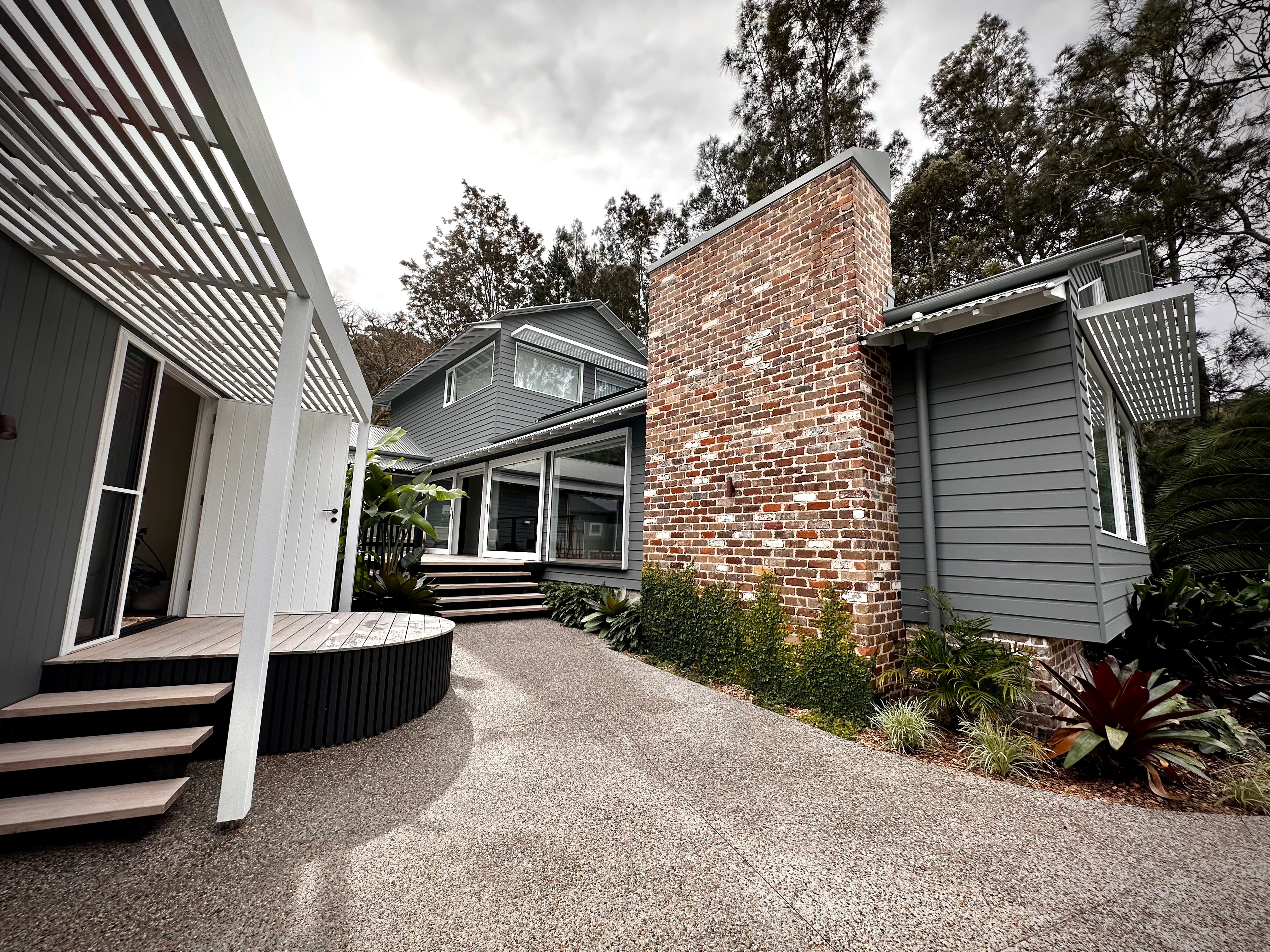
Ahara House, Killcare, built by Lou Projects
Plus, he reckons ‘building should be fun’ for everyone involved. ‘It’s not that stressful’, he says.
This isn’t about squeezing people for more money. It’s about transparency. If we’re paid properly to quote, we’re responsible for getting it right – and that’s what you want.
We consider ourselves consultants in this industry – not just builders. We add far more value than most people realise. So it’s fair to be paid like consultants.
I don’t know about everyone else, but I’m here to stay. I want Lou Projects to be around for the next 20+ years. What’s the point of getting a cheap build if your builder isn’t going to be around next year to fix things when they inevitably come up?
At the end of the day, we need to profit on every job. Not to gouge, but to sustain. To deliver quality. To keep showing up for clients, every day, for decades to come.
Follow Lou Projects on Instagram for pics of projects, video walk-throughs, and more straight-talking.
I’ll let you know how we go with that budget.
Good post Annette - interesting and insightful