
Downsizing
Pros and cons

Regular readers will by now have figured out that the title of this newsletter is tongue-in-cheek. Ironic. Not exactly accurate. Because what I’ve actually done is sell a biggish house only to pour the proceeds into another biggish house.
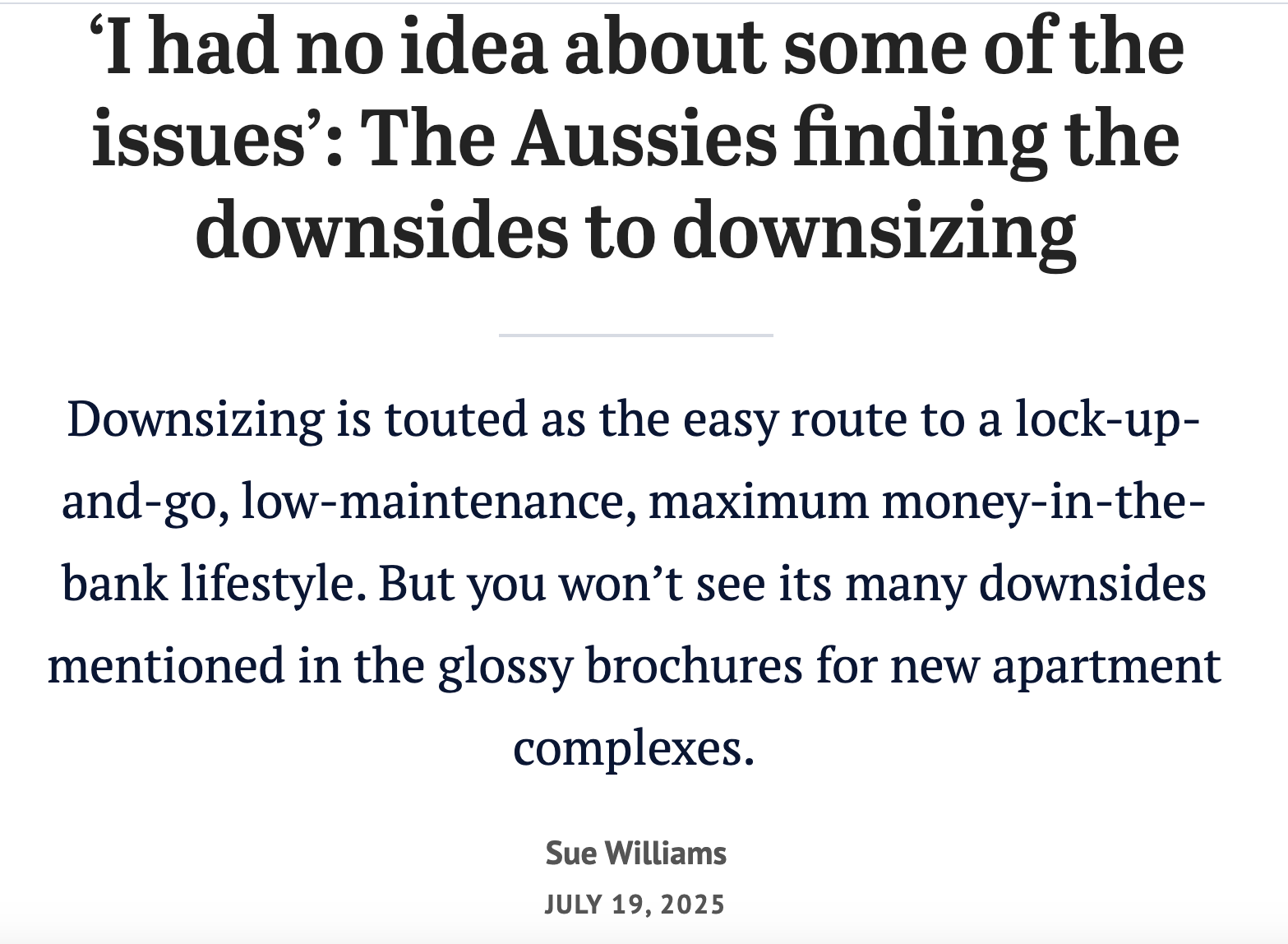
So what’s going on? An article by Sue Williams in the Sydney Morning Herald last weekend delved into this fraught question of downsizing. [A pause here to note that this is something of a first-world problem, as they say, and mostly a concern of cashed-up boomers—but bear with me.]
The ‘expected’ path of a downsizer
Many people, heading into living on a retirement income, the family having flown the nest, decide that they don’t need such a big house, and it would be sensible to move into an apartment. There are plenty of downsizers who talk ecstatically about ‘clearing out the junk of the years’ and ‘low maintenance’ and ‘no lawn mowing’.
As Williams says:
State governments across Australia are all busily trying to persuade empty nesters to free up their big family houses for the next generation and move into apartments or smaller town homes, terraces and villas to make space for higher-density developments. The Australian Taxation Office offers generous superannuation concessions to sweeten the deal… Politicians, developers and real estate agents alike regularly portray downsizing as the delectable lifestyle dream. Think no lawns to mow, no jobs around the house every weekend, the chance to pay off the mortgage with cash left over after the new purchase, better security and usually living closer to cities in all their magnificent amenity.
Downsizers choosing apartments have become a major part of the market – up to 40 per cent of demand, according to Mirvac’s CEO for development, Stuart Penklis.
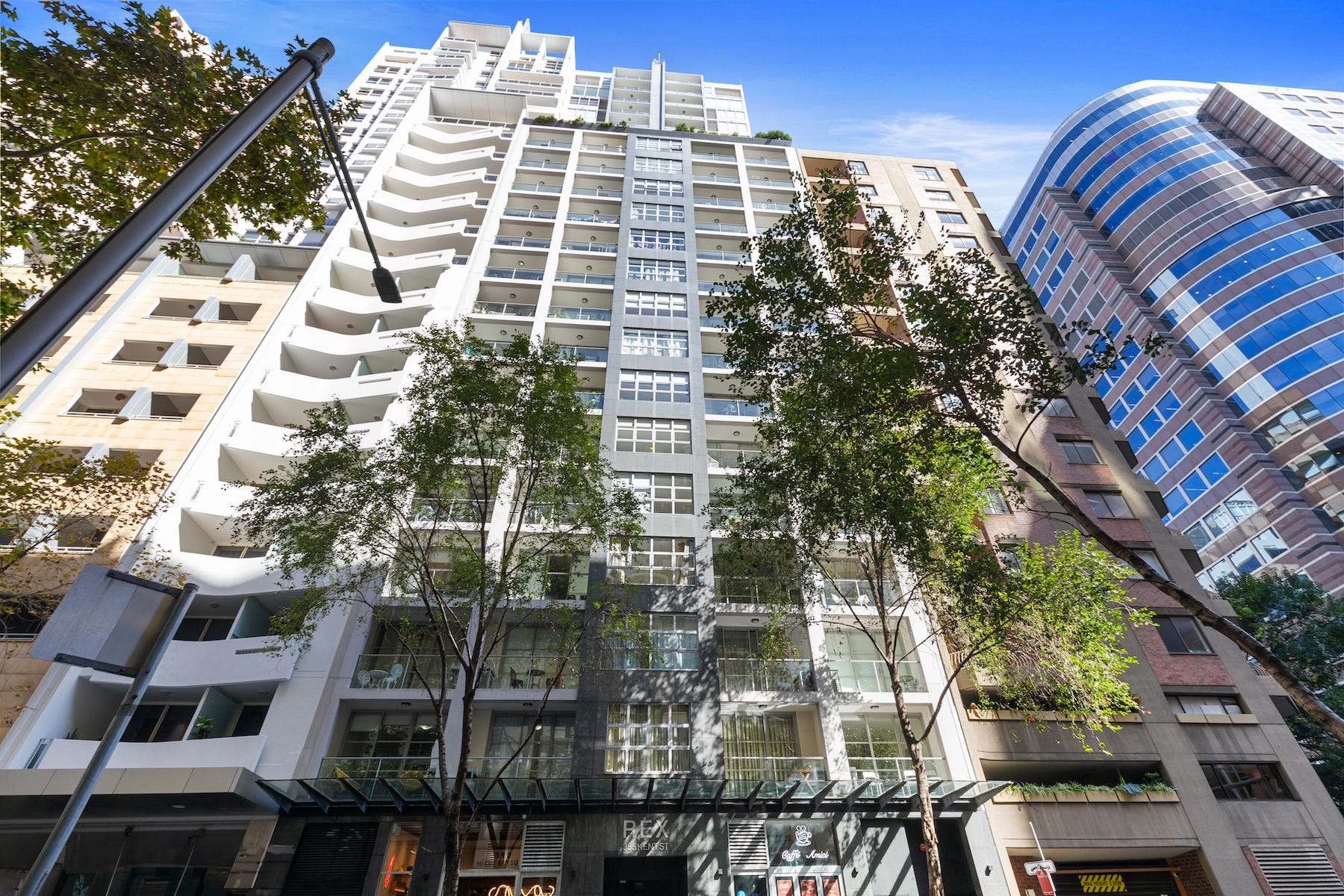
Move into an apartment? [source]
But the people Sue Williams interviewed had struck a few snags.
What problems?
“The whole downsizing experience hasn’t been as smooth or as enjoyable as we’d hoped. Moving from a large home to here was a big decision, and it took my wife considerable time to come on board. But it’s been soured by a lot of things that happened along the way.”
This interviewee and his wife sold a four-bedroom house in the ‘burbs’ and moved into a two-bedroom apartment in the city (Melbourne) which they bought off the plan. But instead of saving time on lawn mowing, he’s found himself spending time on sorting out slow-to-be-rectified defects. Then they were told they had to pay extra to access the pool and gym in the complex.
Missing the open space
He says sadly, “In a way we all miss our old house. My wife misses it a lot and probably our little dog does, too. She loved the open space and the dog liked to run straight out into the backyard.”
Williams uses the evocative phrase: “a claustrophobic nightmare”.
“an absolute frigging nightmare”
This is how another interviewee described his move from a large house in Chatswood to a two-bedroom apartment in Neutral Bay:
“I downsized from a nice four-bedroom house on a very nice block into a two-bedroom apartment and it’s been a disaster. It’s the worst decision I ever made, and I feel quite embittered about it all.”
He wanted a break from mowing lawns [memo: you can hire a bloke to do that].
“We do have a nice private apartment, and it has shops and 100 restaurants within walking distance, and it’s low maintenance,” he says. “But we have four strata schemes here with residential and retail, with an overarching building management committee, and we pay so much in strata levies. I led a coup on the committee because there was such a lack of oversight over contracts and quotes and spending, and I’ve been on a relentless crusade ever since to reduce costs.”
Moving away from your community
Another interviewee, at the young age of 72, sold up her home in lively, multi-cultural inner west Enmore and moved to a retirement village in the country.
“I know it sounds bad, but it’s all old people living here, and it’s stressful hearing about their medical problems, and seeing them not doing so well. It’s not like living in a normal community where you have people of all ages and interests, and kids around.”
The retirement village, though it may be a brilliant answer for some, is not universally popular:
“These people here are quite suburban and conventional. [ouch!] I don’t feel I have anything in common with them. Also, with a retirement village, you don’t own your home, you’re leasing like a tenant and can’t make the decisions about your home you used to. I really wish I was back there and hadn’t left.”
Any good reasons to downsize?
• You might need a single-level home as you get old and doddery
• You may still owe on your mortgage, and selling the big place can wipe that out, or free up capital for those balmy retirement years.
• No lawn mowing
The economics
Williams reports that downsizers “can be shocked by the discovery that apartments, especially new ones, can be just as expensive as the houses they sell.”
I can confirm that this was true in my area of Sydney. Since I certainly didn’t want to move out to the country (see above) nor into a retirement village (see above), I looked at apartments around my area. The asking prices were close to what it is going to cost to build a new house.
Plus with two- or three-bed downsizer units, strata levies can cost anything from $1500 a quarter to more than $20,000 a quarter.
“We pay $10,000 to $12,000 a year, which can be just like paying a mortgage,” says one disgruntled downsizer.
“We have things here like a building management contract that lasts for 24 years – locked away just prior to the government changing the rules to make the contracts last for a maximum of three years. And we owners have no say in how the building is run, we receive no information and see no tenders… no one has been able to recoup that money with sales since. No apartments have sold for a higher price. I was all for downsizing, but I had no idea about some of the issues.”
Strata Levies: Expensive and complicated? [source]
The value of the smaller apartment rankles with quite a few:
…he’s horrified by how much his old house has increased in value, while his apartment has appreciated barely at all. “From a financial point of view, it’s absolutely disastrous,” he says. “If I’d have kept that lovely house on a beautiful block with a big workshop and garage, I’d be sitting on a goldmine.”
Size is everything
Apartments are so often minute. I walked around many of them and wondered how I would fit even the absolute minimum of my precious things into it. If any of them had just had that one extra room, but they didn’t. Williams reports:
… there’s a national shortage of quality three-bedroom apartments that might appeal to empty nesters who often like to turn one bedroom into a study or workroom and have a spare bedroom where their grandchildren can stay. The 2021 census reported that only 16 per cent of new apartments in Sydney had three or more bedrooms, compared to 60 per cent with two bedrooms.
Just pay a lawn-mower man (or woman)
As the downsizer in Neutral Bay grumbled:
“On average, I now spend two hours a day, seven days a week, on strata business; it’s like another job. And I cop a lot of abuse from other owners. Unfortunately, more than 50 per cent of the apartments here are tenanted, and a lot of the owners just don’t want to know, so I end up liaising with the part-time building manager about everything. I wanted a break from mowing lawns but, in retrospect, I should just have paid someone else to do them.”
Yep.
People also miss their garden, or pottering around in the shed. Williams quotes the Victorian director of the peak apartment-owners body, the Owners Corporation Network, who suggest you join a community garden or Men’s Shed. (I’m not sure that’s for me.)
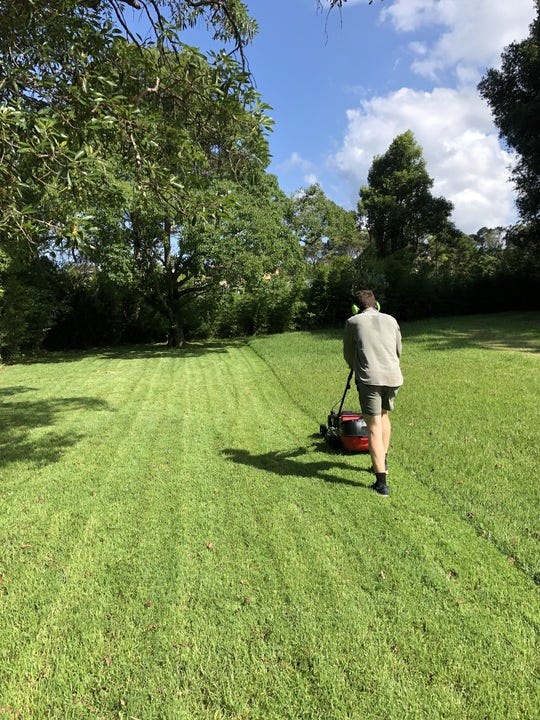
Lawnmowing. Just pay a bloke to do it. [source]
Is building the way to go?
The final interviewee was the saddest: a 65 year old lady who had sold up and decided to build something smaller:
[she] took out a contract for a much smaller home to be built within the same Brisbane outer suburb. But delays from bad weather have plagued the build. “I am absolutely trapped now, with a house that’s not finished and another one that’s costing me a fortune,” she says, her voice thick with emotion. “It’s draining my savings and I’m drawing down on my pension and the builders seem in no rush at all to finish it. Who knows where this will end? I dearly wish I’d never even started.”
Of course, this is not me. *gulp*
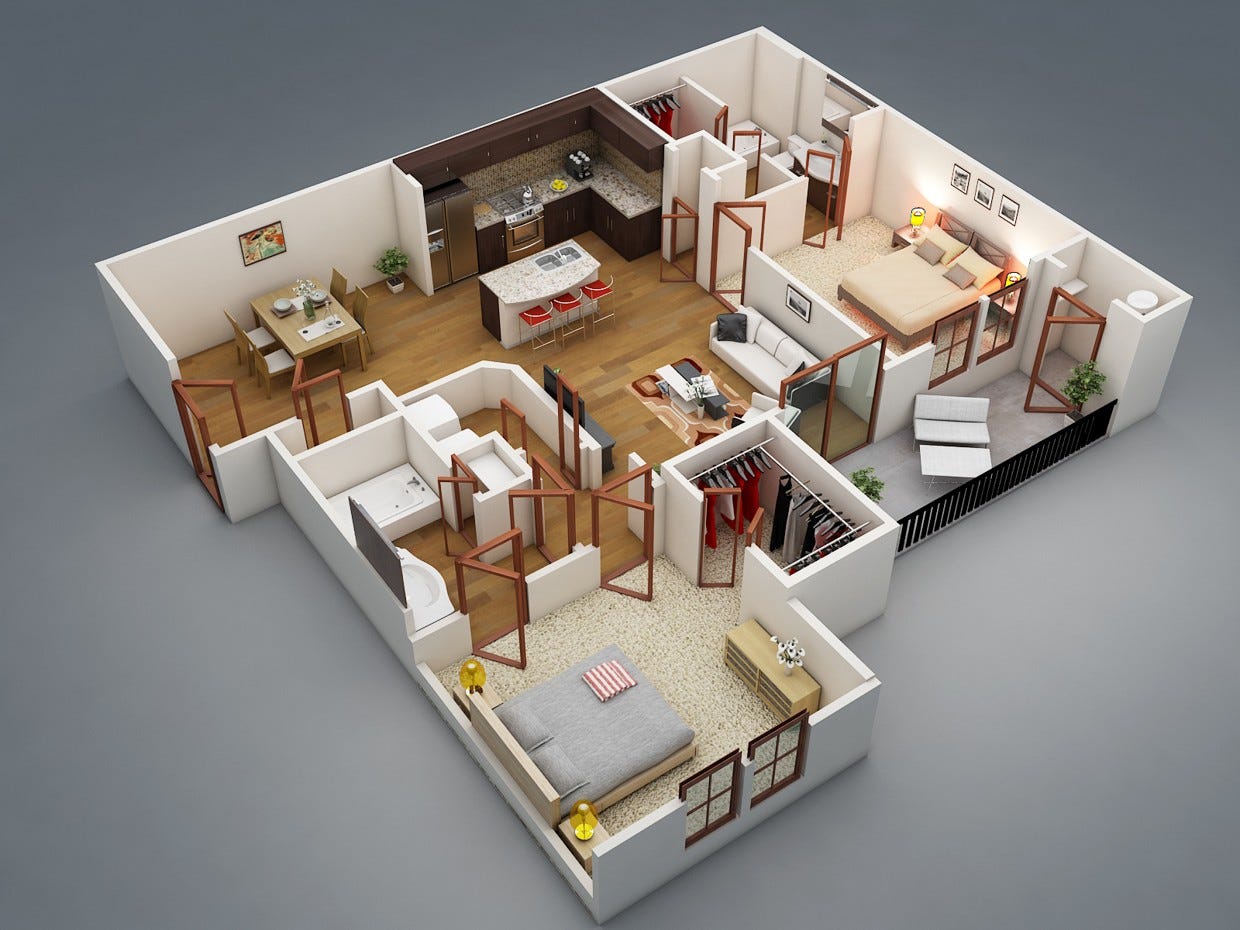
A two-bedroom apartment. Where would the piano go? [source]
My reasons?
What were my reasons for declining the small apartment and the Body Corporate experience?
Number One: the thrill of the creative project of designing and building a wonderful house which will last for 100 years and be eco-friendly.
Number Two: being able to keep all the precious stuff I want to keep around me: the piano, the books, the photo albums.
They’re the main reasons.
I can now reveal, however, that in the amended plans the footprint of my house has shrunk: from 260 sqm to just under 200 sqm.
So I have downsized. In a sense.
If you have a spare five minutes, you might like to watch the handsome Lorenzo, a London-based architect, explain why downsizing is not just a practical decision. “Your home is about your identity”: